 In Japan we are foreigners. We look different. We smell different (apparently). We speak the language in a funny way. We don't always manage to do things the 'right' way. We stick out. We are a bit like aliens. As a matter of fact, that is exactly what we are and we even have to carry around a card to prove it. Along the top of the card with our photo underneath there are nine 'kanji' (the Chinese characters) with a translation below which tells us this our Certificate of Alien Registration. Yes, we are certified aliens. No wonder we get odd looks at times. When we bought a new bike the other day, we received the usual user's manual which told us all we needed to know, complete with lots of illustrated drawings, about riding a bike. It was all in Japanese of course but the front page very helpfully had a sentence in English in large capital letters which read exactly as follows - FOR YOUR SAFETY AND COMFORT, IF YOU ARE ALIEN WHO LIVE IN JAPAN, PLEASE ASK SOMEONE WHO UNDERSTAND THIS MANUAL TO MAKE DETAILED EXPLANATION FOR YOU. Yes, we are aliens here. We will never truly be an insider. But, in a strange way, because we are 'outsiders' there can be a certain attractiveness in that too and our 'foreign-ness' can be a way God can use to connect us with people and then connect them to Jesus. And when that happens, what is the result? The Japanese who believes then also becomes an alien because that is just how the Bible describes followers of Jesus - aliens and strangers in the world, whose ultimate citizenship is in heaven. We look forward to seeing many more aliens in Japan!
Tuesday, May 25, 2010
Strangers in a foreign land
In Japan we are foreigners. We look different. We smell different (apparently). We speak the language in a funny way. We don't always manage to do things the 'right' way. We stick out. We are a bit like aliens. As a matter of fact, that is exactly what we are and we even have to carry around a card to prove it. Along the top of the card with our photo underneath there are nine 'kanji' (the Chinese characters) with a translation below which tells us this our Certificate of Alien Registration. Yes, we are certified aliens. No wonder we get odd looks at times. When we bought a new bike the other day, we received the usual user's manual which told us all we needed to know, complete with lots of illustrated drawings, about riding a bike. It was all in Japanese of course but the front page very helpfully had a sentence in English in large capital letters which read exactly as follows - FOR YOUR SAFETY AND COMFORT, IF YOU ARE ALIEN WHO LIVE IN JAPAN, PLEASE ASK SOMEONE WHO UNDERSTAND THIS MANUAL TO MAKE DETAILED EXPLANATION FOR YOU. Yes, we are aliens here. We will never truly be an insider. But, in a strange way, because we are 'outsiders' there can be a certain attractiveness in that too and our 'foreign-ness' can be a way God can use to connect us with people and then connect them to Jesus. And when that happens, what is the result? The Japanese who believes then also becomes an alien because that is just how the Bible describes followers of Jesus - aliens and strangers in the world, whose ultimate citizenship is in heaven. We look forward to seeing many more aliens in Japan!

Wednesday, May 19, 2010
Our 100th blog
 While we were back home in Scotland for a year, we thought we would start a blog as a way of telling the story of what it is like to come back to Japan and start a church from zero. The blog started last June and here we are already at the 100th post. While we have tried to share the story of the start of Hiragishi Izumi Church, we have also shared our day-to-day experiences and tried too to give some insights into the culture and life here for folks back home. It has certainly been an encouragement to us to hear of people who have read and appreciated what we have shared over the last year. Being involved in the work of sharing the gospel is very much a partnership. We need and indeed treasure so much people who care, who pray and who encourage. While we are thinking about the number 100, we were reminded of a wonderful man who was still praying faithfully for us and composing letters to us in the neatest hand-writing even when he had reached the age of 100 two or three years ago. Those who pray and encourage are often unseen and happy to be in the background. But they (we really should say you) form such a vital ingredient in any work of sharing the good news of Jesus. So as we move on to the next hundred posts, thank you so much for reading our news, for praying for the people of Japan and for being an encouragement to us.
Sunday, May 16, 2010
Cherry blossoms
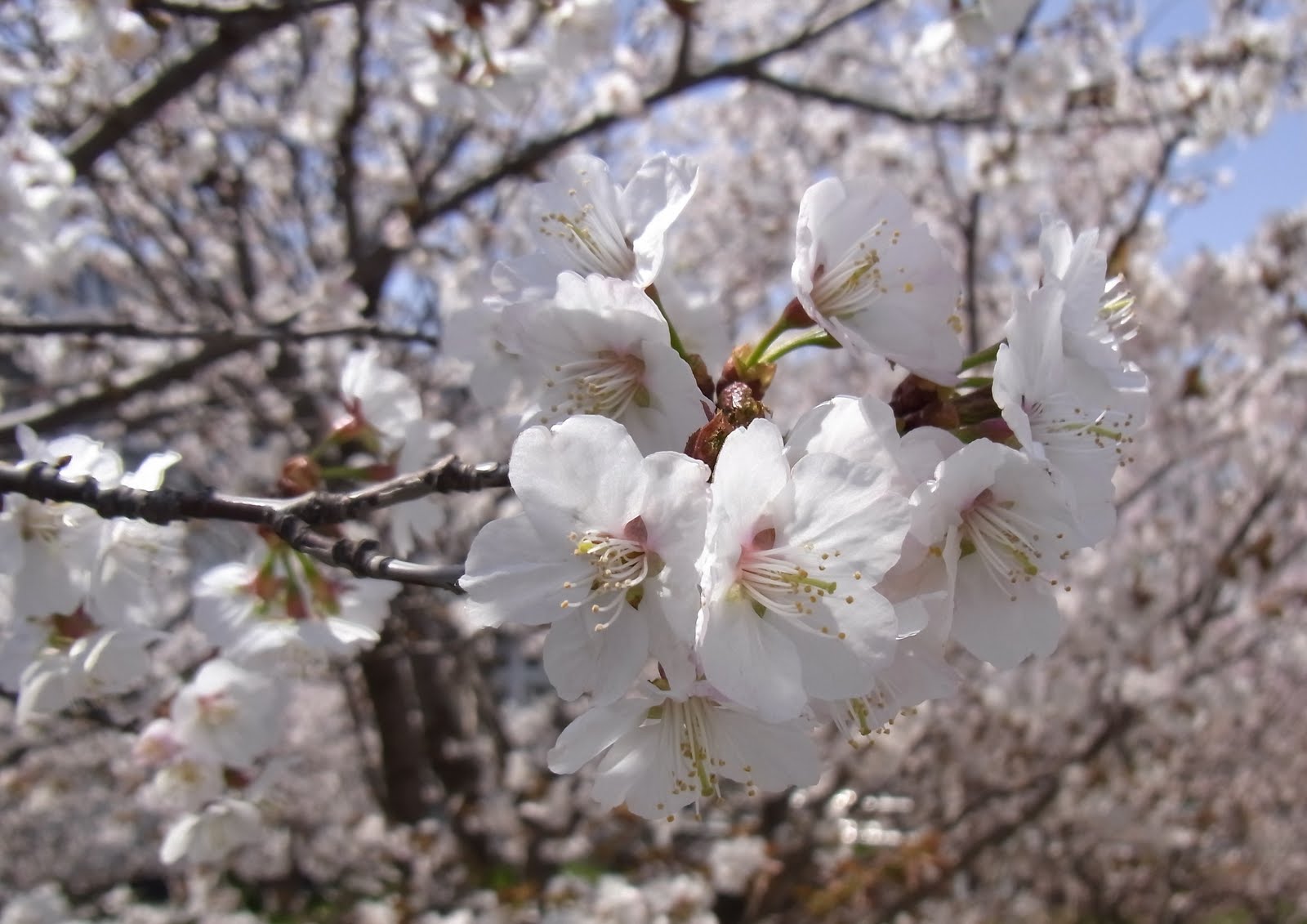 Over the last week it has been cherry blossom season here in Hokkaido. Being the most northerly and therefore the coldest of the main Japanese islands, we are always the last to enjoy the pinks and whites at this time of year. It's always so good here to see signs of life and colour after the long winter. People like to go to view the cherry blossoms (there is a word for that - hanami) and others will have a picnic under the trees. Our house benefits from having two large cherry blossom trees just outside our windows - great to waken up in the morning and look out on them. Sadly the blossom does not last. After a week or so, it's all gone. The cherry blossom is richly symbolic in Japanese culture. One such would be a reminder of mortality. The life of the cherry blossom is short. And as we look at the cherry blossoms, it's a reminder to us that while many people around us are appreciating the beauty of the blossom, so few know the one who created the beauty of these trees. Life is short. Our time here is short. But we bear a message that points to life and not death. As we were thinking in our church service this afternoon, our task is to bear witness to that message in the hope that many in Japan can find the way to life.
Tuesday, May 11, 2010
Pizza?
 We have seen many different kinds of pizza since we arrived in Japan - pizza covered in mayonnaise, squid pizza, seaweed pizza, but an advert from a local pizza company through our door recently surprised even us. Strawberry dessert pizza! The topping is a mouth-watering strawberry syrup and fresh cream. We have not so far rushed out to order it. Some of the combinations here are somewhat weird - to Western taste buds anyway. The other day we sampled spinach cheesecake. Then while in a chocolate shop looking for some Mother's Day goodies, we spotted packets of mildly-chocolate flavoured beef curry! This particular chocolate shop is one of the most well-known in Hokkaido and frequently comes up with new creations. It seems that 12th June is a special day here for giving something to your loved one - it's the first time we've come across that day. Strawberry again makes an appearance on the adverts for this day - how about a box of strawberry and fromage macaroon? Or maybe some green tea flavoured fresh cream chocolates instead? If none of that appeals, then there is always the restaurant where you can get chocolate-topped pizza. Perhaps we should just stick to sushi and tempura.
 Saturday, May 8, 2010
Children's Day
 The end of the Golden Week holiday in Japan is marked with a day called Children's Day. It used to be called Boy's Day but was changed some years ago. In many places you can see large, colourful carp streamers flying in people's gardens or at roadsides. The carp is known for being able to swim upstream and is meant to symbolise the energy and power desired in boys. Some people may display samurai dolls inside their house; others will eat special sweet sticky rice dumplings wrapped in bamboo leaves. We received some from a neighbour. Just the day before Children's Day, the government issued some statistics revealing that the number of children under the age of 15 in Japan had fallen for the 29th consecutive year. Children now comprise just 13% of the population. These are sobering figures in a land where many people live well into their 70s and 80s. Schools are closing or merging as the imbalance in the population becomes even more marked. An ageing population and low birth rate makes for challenging times both now and in the future for the land of Japan. And it does not help that there are more dogs than children under the age of 12. Maybe soon we'll be having Dog's Day in Japan.
Thursday, May 6, 2010
licensed to drive
 When we first came to Japan nearly 12 years ago we were able to use our UK driving licenses to apply for Japanese ones. The system here is quite complex but seeks to reward good behaviour on the roads. The first licence you get is a has a blue stripe and lasts for 3 years. If during that time you are very good and get no points on your licence you then get a gold stripe one which lasts for 5 years. 1-3 points on your licence will also get you a 5 year one, but only with a blue stripe. And if you have more that you only get a 3 year blue one again. A notice comes in the post that your licence will expire and you have two months to renew. In Otaru we just went to the local police station, but in Sapporo there are 3 designated places you can go. This morning Lorna went to renew hers. The place was due to open at 8:45 but even though she arrived before then, the place was already teeming with people. You queue to hand in your posted form and confirm there are no changes. Then you get a form which you go and fill in and then queue at the next place to pay the fee. For this you get stamps which you go and stick on to another form and seal them with your personal seal. Then another queue for an eye test before going upstairs to hand all your forms in. Once they're all checked you are called to go into another room and have your photo taken. Then finally you can go for your lecture. Attendance at a lecture is compulsory, but here's where the benefit of being good comes in. If you're getting a gold licence you only have to sit through a 30 minute lecture. A blue 5 year licence means a one hour lecture, with 2 hours for the 3 year one. Having said that, the man giving the lecture this morning may only have spoken for 30 minutes but he was so fast that he must have crammed in at least 45 minutes' worth of material. The lecture consists of statistics to show that whereas our are used to be the worst for deaths on the road it is now the second worst in the country, accompanied by lots of photos of recent accidents with advice on how to avoid them. To summarise the 30 minutes: wear a seatbelt, drive slowly and watch out for other drivers. But it was all delivered to a complex powerpoint and accompanied by 2 books of over 100 pages each which you are then to read at home. All of this was completed in just over an hour, and at the end of it you walk out with your sparkling new licence and the knowledge of your reward being that you don't have to go back for another 5 years.
Saturday, May 1, 2010
Being polite
 Calum has just had his tenth birthday and thought he would like six of his football friends for a birthday tea and sleepover. His mad parents looked forward to having eight boys in the house! The translation of the Japanese word for 'sleepover' would be something like 'stay over' which is perhaps a more accurate description as very little sleep is involved. All children in Japan are taught basic phrases from an early stage which should be used whenever you visit someone's house and receive food. There is a word which is said as they come in to excuse themselves for being in your house; there is a word to be said as they begin eating the food; there is a word to be used after eating to thank the host for what they have eaten; and there is another word to be used when leaving the house to excuse themselves for having been in your house. We are always amazed at how children here quite happily squeeze themselves into a small space - everyone is used to it. And of course there were many expressions of thanks afterwards from the other mothers. Getting manners right is important here. There are set ways to do things and set ways to say things. Sometimes it might seem rather rule-based. But there is always a politeness and sense of respect shown by Japanese children which is something we really appreciate about living in this land.
Subscribe to:
Posts (Atom)


